
The questions that I will offer answers to include:
• What does the symbol really depict? • What sources is the symbol based on? • Why does it resemble the Zierscheibe finds? • Why did Himmler put it on the North Tower floor?
Introducing the Infamous Wewelsburg Sun Wheel
One of the most enduring mysteries of the Third Reich—and surely the most iconic one—is the identity of a large sun wheel design in the floor of the North Tower of Wewelsburg Castle in Germany. For over 40 years from the end of WWII, it was all but completely ignored, but then suddenly became popularized in the early 1990s as a “black sun,” largely through the novel Die Schwarze Sonne von Tashi Lhunpo (The Black Sun of Tashi Lhunpo), published in 1991. In this entry in the occult-Nazi thriller genre, the symbol is called a black sun there, and it’s used as a mark branded on the assassination victims of a cult. From that point in time, various crowds of people have latched onto the symbol under the moniker of the “Black Sun.” It seems the neo-nazi fanbois will latch onto anything “edgy” associated with the Third Reich, and many of them have latched onto this as a kind of substitute swastika (for use where the swastika is formally banned or otherwise unacceptable, for instance), among other things. And in response, the antifa and intelligentsia have latched onto it by demonizing it. It’s a rather ridiculous game to watch, especially for a symbol that never adorned Nazi flags, did not march with their armies, and was certainly never meant as a substitute swastika. So it is needful to get to the bottom of this mysterious symbol, even if it will not change the fanatics’ views about it. It is a symbol which, as we shall see, has its best explanation in something that had nothing to do with Nazi ideology at all. On the other hand, various individuals and groups of occult or neopagan orientation work with the symbol in non-nazi uses, and they are probably the ones that will be most delighted with what I say about the symbol in this essay.
Context is key. Discover the original setting for this symbol in Wewelsburg, the castle that Himmler was turning into a spiritual headquarters for the SS.
Online depictions of this symbol vary widely. Discover how only the original source of the controversy has all the keys needed to solve the mystery.
This occult sun wheel was never meant for the masses. Find out who it was really intended for as part of Himmler's attempt to revive the Knights of the Round Table.
.jpg)
The Grail Hall in Wewelsburg
Featuring the sun wheel mosaic that's the original source of the mystery. Accept no substitutions. Photo by Dirk Vorderstraße, CC License. https://creativecommons.org/licenses/by/2.0/
Whence the "Black Sun"?
But as for the “Black Sun” designation, it is thoroughly an invention of the 1990s, with no connection to the SS. For instance, a former SS folklorist at the castle, Bernhard Frank (1913–2011), had this to say about the designation: "To my knowledge the designation Black Sun was first used after the war. I would like to say in conclusion that I never heard the term Black Sun during peacetime, that is, during my scholarly activity at Wewelsburg Castle, and also not during my wartime leaves. Is the label perhaps an invention—a malicious one I might suggest—of the post-war period?" Malicious or not, “Black Sun” is very much wrong. Recent scholarship summarizes the state of knowledge about the actual meaning or name of the symbol as follows: "All interpretations have one thing in common: They stem exclusively from the recent past and have been applied retrospectively to the sun wheel. There are no known sources from the National Socialist period that provide information about the meaning of the symbol intended at that time or about its name." And yet there does not appear to be any genuinely plausible and complete explanations given for the symbol, whether by scholars or anyone else, after all this time. The neo-nazi fanbois go off on flights of fancy, while the credible scholars just throw up their hands and offer nothing to fill the void. Here, I will do neither—instead, I offer a complete and eminently plausible explanation that solves this mystery at last. To be clear, I have not uncovered any never-before-seen SS documentation regarding the symbol. I’m aware that for some readers, only such documentation could ever settle the mystery. So yes, this essay is speculative, but the reader will see that all my speculations are quite reasonable. There are no flights of fancy here into bizarre Nazi occultism theories about Atlantean technology or white-supremacist Aryan-power rituals. And yet I account for all of the distinctive features of the symbol, including what it’s doing on the castle floor—it had a real, practical value in Himmler’s grand ambitions. My explanation here ought to become the most widely accepted explanation in the absence of SS documentation. And if such SS documentation ever turns up (though it probably won’t), I’m confident that it would substantiate all of my argument here.
Learn how how the Vision of the Grail in the medieval manuscript BnF Manuscrits Français 112 serves as the basis for the design.
Discover how an overlooked medieval German manuscript accounts for both the use of ancient archaeological finds (Zierscheibe) as symbols of the Round Table, and the legendary gold disk that was reputed to sit at Himmler's "Center of the World."
Learn about the now-obscure scholarly publication from 1938 that would point Himmler and Wiligut straight at all the images of the Round Table they would need to make this sun wheel.
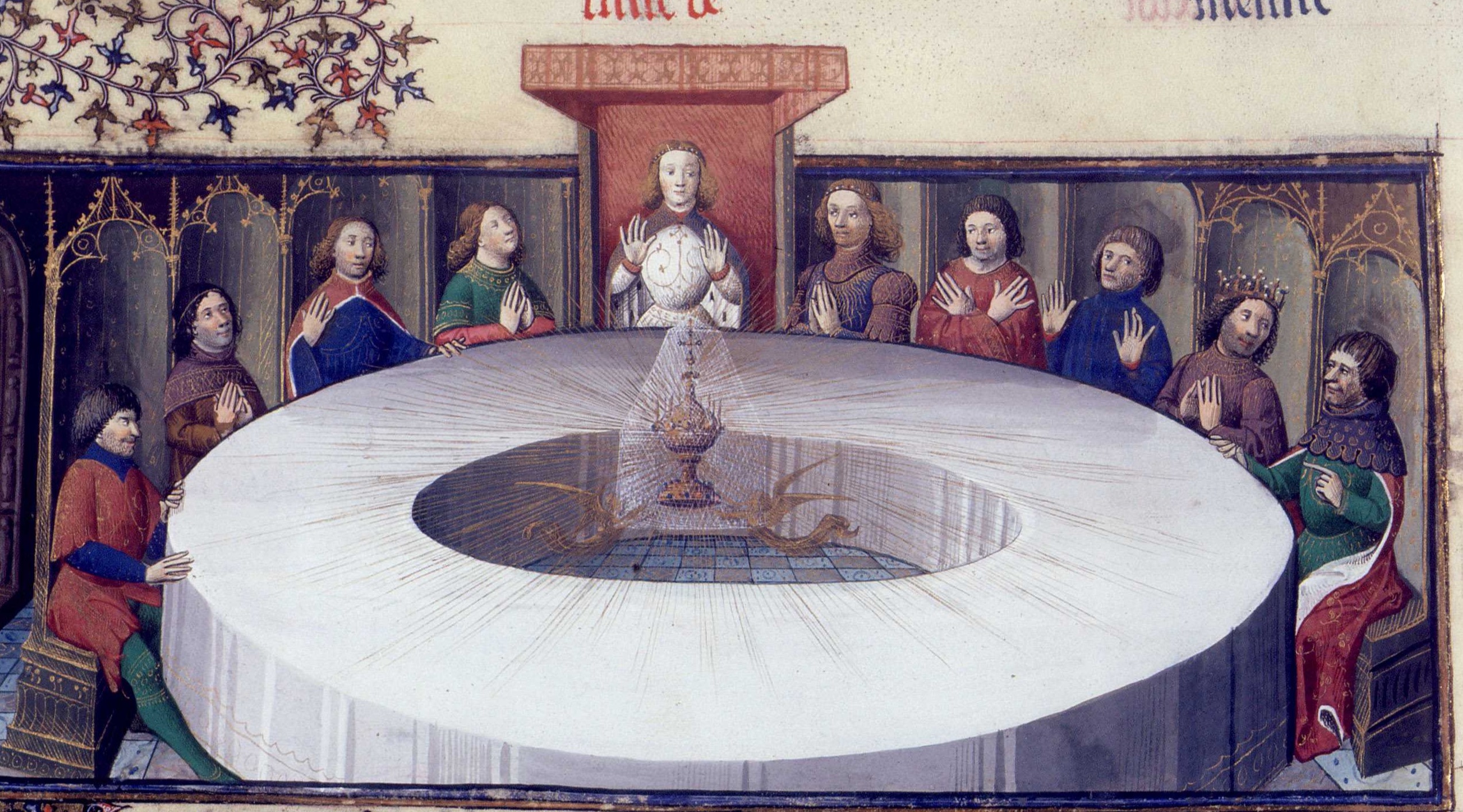
The Foundation of the Design?
Yes, this enchanting image of the Round Table and Grail is one of the major keys to the symbol.
Wewelsburg's So-Called "Black Sun" is Really Himmler's Round Table and Grail
That's the full title of this essay. Quite intentional as the ultimate TL;DR / "bottom line up front" statement.
$12.99
.jpg)
This is the Flagship Essay from Eirik's New Book
This essay is just one of nine in Occult Mead.
It's the only one available in digital format so far.
Occult Mead is Eirik's first essay collection.
Eirik has written lots of poetry, but this time, his occult prose takes the stage.
Not ready for the whole book yet?
Read some of the best of Eirik's occult writing with this digital essay before taking the plunge on the whole book, which is only available in trade paperback.

About the Author
Eirik Westcoat is a Master in the Rune-Gild and a long-time poet in traditional English and Norse alliterative meters. He holds a PhD from the University of Iceland with a dissertation on kraftaskalds, who are poets in post-medieval Icelandic folktales who do magic through improvised poetry. Eirik's published poetry books are Viking Poetry for Heathen Rites (2017), Eagle’s Mead (2019), and Shining Mead (2025). Eirik's first essay book, Occult Mead (2025) features this essay, "Wewelsburg's So-Called 'Black Sun' is Really Himmler's Round Table and Grail."
Advance Praise for "...Himmler's Round Table..."
This will be one of the most talked-about essays on the subject ever. Below is just the beginning of what will be said.
Few modern esoteric symbols have a significance more obscure than the infamous green marble sunwheel in the north tower of the even more infamous Wewelsburg Castle. The common identification of the design with the “black sun” is questionable, since that connection arises more than fifty years after the green marble was laid down. What if the true meaning is a synthesis of various elements of Grail lore, inspired by an ancient design but cast into a modern form imbued with features that draw attention to its location as the centerpiece of Himmler’s Grail Hall? Eirik Westcoat presents precisely this argument, drawing from the perspectives of both scholar and Rune Master to offer an intriguing new interpretation of a symbol that has defied explanation for more than eight decades.
Grand Master of the Order of the Trapezoid
An informed and illuminating inquiry into the origins and meaning of the so-called “Black Sun” and the dark Camelot of Himmler’s Wewelsburg Castle. A must-read for anyone pursuing the path to The Grail.
Poet and author
In the essay “Wewelsburg’s So-Called ‘Black Sun’ is Really Himmler’s Round Table and Grail,” Eirik Westcoat describes the controversial symbol that has had a revival in both political conspiracy theories and contemporary esotericism. In a clarifying manner, the author goes through common misconceptions and describes in a credible way its connection to Wagner’s opera Parsifal and the mysticism that existed in the circle surrounding the SS, among others Karl Maria Wiligut. Eirik Westcoat conveys both valuable historical and symbolist insights.
Author of Nightside of the Runes and Draconian Initiations
Some will say this is the most important essay ever written about the Wewelsburg sun wheel.
In this cautionary tale of invoking lofty spiritual forces, there's a challenge—and a warning—for those who would attempt to declare themselves Knights of the Round Table.
$12.99